What Changes When Iteration Becomes Free
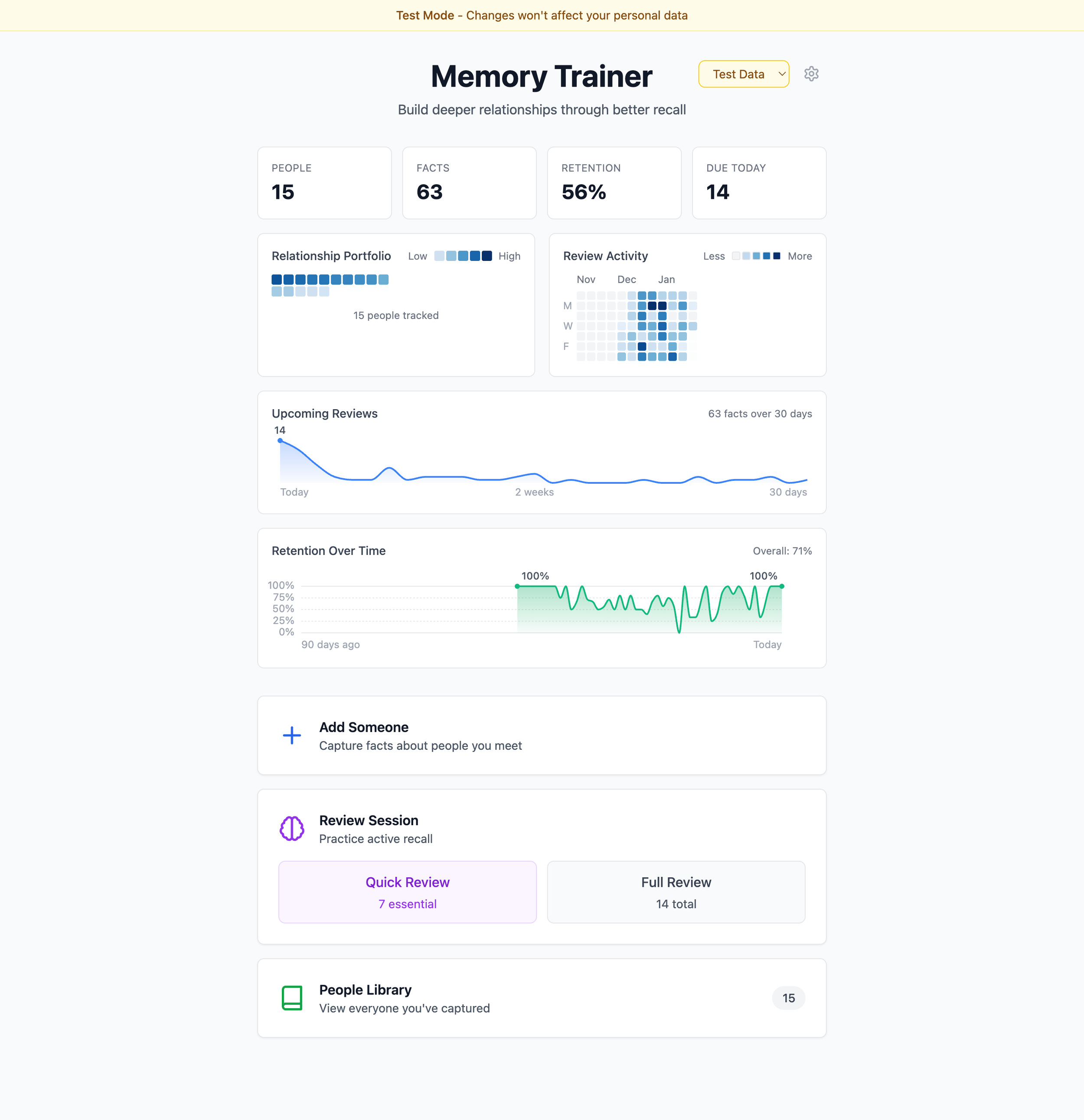
Memory Trainer home page
I built a 4,500-line React app in three days. AI-powered fact extraction, spaced repetition algorithms, data visualizations. The kind of scope that would normally take a senior developer six to eight weeks.
The interesting part isn't the speed. It's what the speed enabled.
The Project
Memory Trainer is a spaced repetition app for remembering facts about people. I built it because relationship depth matters in my work, and my memory doesn't scale. Most tools store information in databases you'll never check. I wanted something that helps you actually internalize what you learn about people.
The tech stack is straightforward: React, Vite, Tailwind, Claude's API for the AI layer. Nothing exotic.
What wasn't standard was how it came together.
The Real Shift
I've built software for decades. The bottleneck has always been iteration cost. Refactoring 2,000 lines means hours of careful work. Changing your data model mid-project means days of cleanup. So you plan extensively upfront, trying to get things right the first time.
With Claude Code, refactoring those 2,000 lines takes minutes. Changing the data model is a conversation, not a crisis.
What I Actually Did Differently
On day one, I built the core app with one data model. By day two, I realized the model was wrong. A field I'd treated as metadata should have been stored with the rest of the content.
Old approach: Live with the awkward design, or spend a day carefully migrating.
New approach: Explain what's wrong, describe the fix, let Claude Code restructure it. Twenty minutes.
I made this kind of change repeatedly. Restructured how data was grouped after using the app and feeling what was missing. Added keyboard shortcuts after noticing friction in my own workflow. Rewrote the visualization layer when the first approach got messy. Changed how AI categorizes content based on what actually mattered in practice.
Each of those iterations would have cost hours or days before. Now they cost minutes. So I made all of them.
What This Changes
Most software is mediocre not because developers lack skill, but because iteration is expensive. You ship the third-best solution because exploring the first-best would take too long.
When iteration cost drops dramatically, you don't just build faster. You build something different—because you can afford to discover what you actually need.
What Didn't Change
I still had to know what I wanted. Claude Code didn't figure out that grouping related facts together would work better than fragmenting them. I noticed that during use and directed the change.
The work shifted from implementation to direction. Deciding what to build. Noticing what wasn't working. Understanding why.
That part is still hard. But the cost of exploring ideas dropped enough that more ideas became worth exploring.
The Numbers
4,571 lines across 17 files. Three days of building. At least five major refactors that would have taken hours each. AI extraction, spaced repetition, visualizations, data management. Fully functional, not a demo.
A senior developer with clear requirements might do this in two to four weeks. With realistic iteration and discovery? Six to eight weeks.
The speedup is real. But the number undersells it. The speedup enabled a quality of exploration I wouldn't have attempted otherwise.
What This Means
I'm not a professional developer anymore. I'm a product person who can write code when needed. Yet I built something in three days that would have been a significant project for a full-time engineer.
Not "AI writes code faster." The economics of building software changed.
If you have product sense and can direct development clearly, you can build things that weren't worth building before. Small tools. Niche products. Personal software that solves your specific problem.
The bottleneck moved. It used to be implementation. Now it's knowing what you want—and being willing to iterate until you find it.
Memory Trainer is a working prototype for my own use, not a production app. But that's part of the point. Three days got me something I actually use daily.
I turned my prototype into an app called Known, try it at https://beknown.pro/
This is the kind of thinking I bring to my work with leaders. If it resonates, let’s talk.
Schedule a conversation →